
Bus Shelters & Transit Shelters
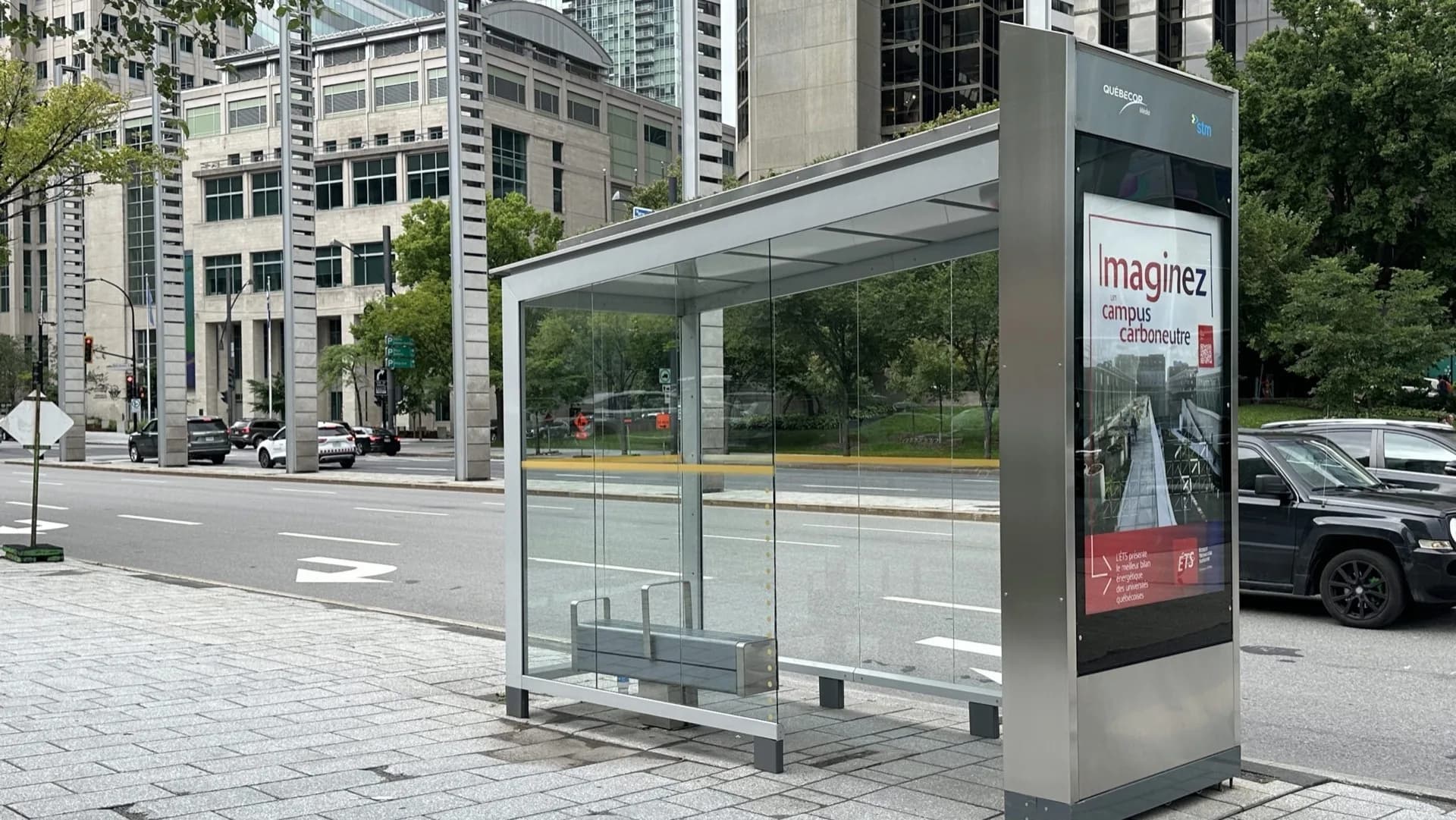
Bus shelters, bus stop shelters and transit shelters engineered for Canadian conditions — supplied, installed and maintained nationwide. Standard, solar, heated, accessible, smart, advertising, modular and custom models for transit authorities and private sites.
Who we supply
Bus stop shelters for transit authorities, municipalities and private sites
Transit authority bus shelters. Stamped engineering for snow and wind loads by province, AODA / accessibility-code compliance, prevailing-wage installation crews, and a 48-hour replacement-parts SLA. We supply transit shelters to TTC, STM, Translink, Calgary Transit, OC Transpo and dozens of regional authorities.
Bus stop shelters for private sites. Universities, hospitals, industrial campuses, shopping centres and seniors residences. Same engineering standard as municipal projects, simpler procurement — quote, manufacture, deliver, install. Standard models ship in 6–8 weeks; custom in 10–12.
Every climate zone covered. Cold-rated gaskets and footings to local frost depth on every prairie and atlantic install. Heated shelters with cold-weather glazing for routes north of 55°. Solar-powered LED lighting where grid-tie isn’t feasible.
Bilingual procurement support. Submission documents, technical data sheets and installation drawings available in English and French. Province-stamped engineer drawings on request for ON, QC, BC, AB and any other jurisdiction requiring local seal.
All bus shelter models
Procurement-ready specifications, transparent pricing, and stamped engineering for every climate zone in the country.
Standard Bus Shelters
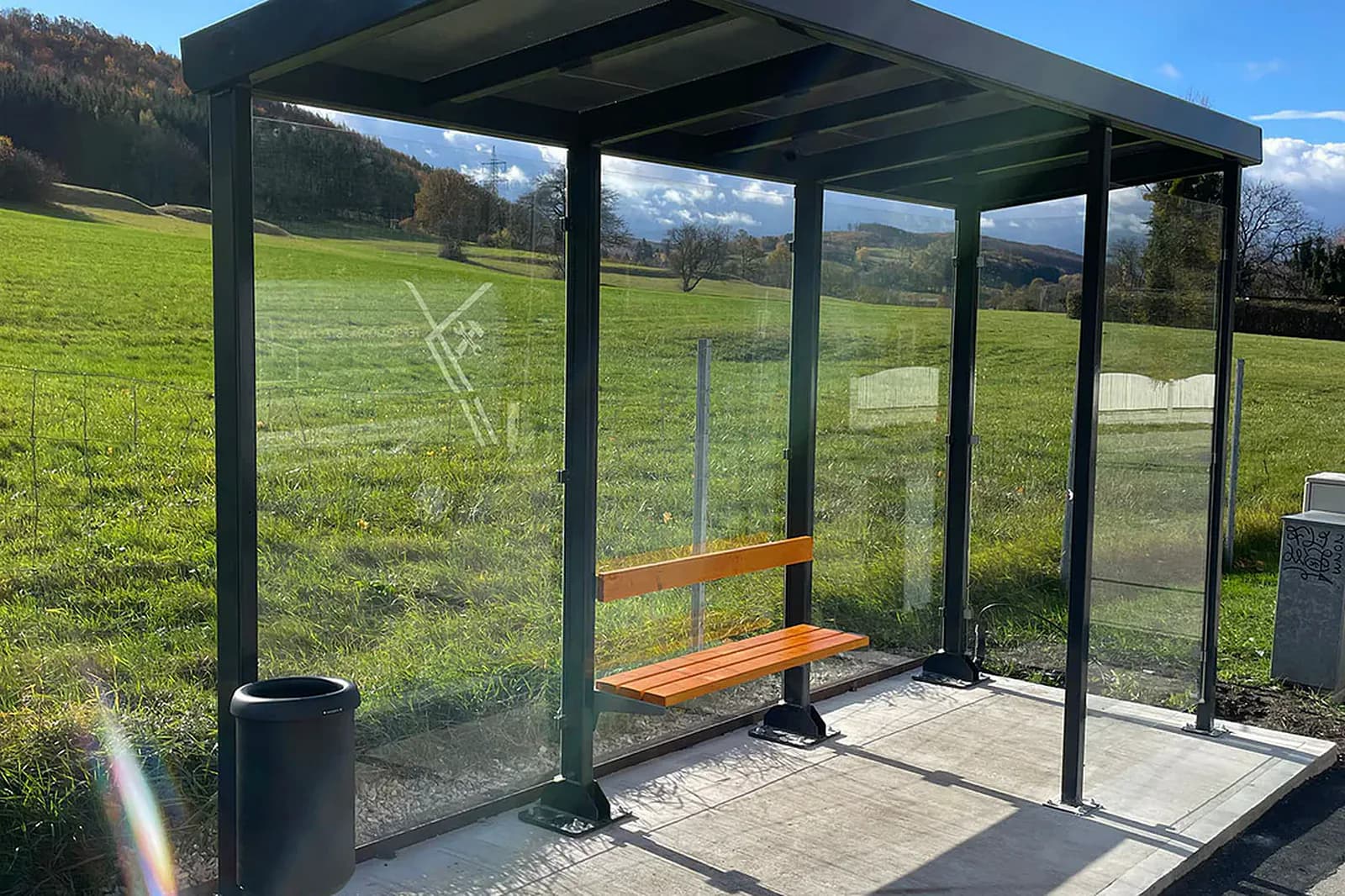
Standard bus shelters are the workhorse of every Canadian transit system — a freestanding or cantilever-mounted enclosure with three glazed walls, an integrated bench, and a roof sized for local snow load. BusShelters.ca builds standard shelters in 4-foot, 6-foot, 8-foot, 10-foot, and 12-foot lengths, all on a 6063-T6 aluminum frame with 6 mm tempered safety glass to CSA Z97.1. Roofs are aluminum composite panel (ACM) or polycarbonate twin-wall, sloped 3° toward the rear to shed snow away from the boarding edge. Every standard shelter ships with stamped engineering for the destination province's snow load (Ss 1.0–4.0 kPa) and wind load (q1/50 0.40–0.95 kPa) per the National Building Code of Canada 2020. Footings are sized to the municipal frost depth — 0.6 m in Vancouver, 1.2 m in Toronto, 1.5 m in Calgary, 2.0 m in Winnipeg, 2.4 m in Edmonton, 3.0 m in Yellowknife — and shipped with anchor templates for cast-in-place or pre-cast pier installation. Engineering specifications The bench is a powder-coated aluminum slat assembly, 1.8–3.0 m long, with anti-skateboard caps and an optional armrest for AODA / CSA B651-18 accessibility compliance. Side walls accept clip-in advertising panels, route-map holders, or LED-lit info backers. Anti-graffiti treatment is a sacrificial film standard, with permanent fluoropolymer coating available for high-vandalism corridors. Lead time is 6–10 weeks for standard configurations and 8–14 weeks for non-standard sizes; replacement parts ship in 48 hours from our Brantford, Ontario warehouse. Standard shelters are specified by Toronto Transit Commission (TTC), OC Transpo (Ottawa), TransLink (Vancouver), Calgary Transit, Edmonton Transit Service, and 80+ smaller Canadian agencies. Pricing starts at $6,500 for the structure and $2,500 for installation including footings; volume orders of 20+ units reduce per-unit pricing 15–25%. Installation, warranty, and support Installation is performed by bonded and insured BusShelters.ca crews working under provincial trade-permit with all required worksite signage, traffic-management plans, and locate-clearance documentation. A typical standard shelter is footing-poured day 1, structure-erected day 3, glazed and benched day 4 — total 3–4 working days per site once permits are clear. We provide a 10-year structural warranty on the aluminum frame, 5-year warranty on glazing and bench, 2-year warranty on lighting, and a 48-hour replacement-parts SLA from our Brantford warehouse. Every project includes a digital as-built package (drawings, photos, GPS coordinates, manufacturer's serials) so your maintenance and asset-management systems have a clean record on day one. Annual maintenance contracts cover panel replacement, anti-graffiti refresh, bench powder-coat touch-up, and structural inspection — typically $300–$600 per shelter per year depending on cleaning frequency. Material and configuration variants The standard bus shelter is built around 6063-T6 aluminum and 6 mm tempered glass, but the same engineering envelope supports a full range of bus shelter types for site-specific contexts. Stainless steel bus shelters (316L marine-grade) are specified for coastal Atlantic and Pacific exposure. Glass bus shelters with all-glazed walls suit heritage and pedestrian-priority districts. Concrete bus shelters (precast shell) are used in high-vandalism corridors. Wooden bus shelters / timber bus shelters in FSC cedar or thermally-modified ash match heritage parks and campuses. Cantilever bus shelters mount on a single rear post for narrow sidewalk geometries. Enclosed bus shelters (4-wall + door) pair with the heated option for cold-weather waiting. Modular and prefab bus shelters ship in standardised bays for any length from 4 ft to 60 ft. Portable and temporary bus shelters use ballasted bases for construction-detour and festival deployments. Green-roof / eco bus shelters integrate sedum trays for stormwater attenuation and LEED v4 alignment. See bus shelter types and configurations for the full catalogue with materials, pricing uplift, and lead times for each variant. Key Takeaway: Climate-rated, AODA-compliant, and stamped-engineered for Canadian transit deployment — full procurement documentation included.
Solar-Powered Bus Shelters
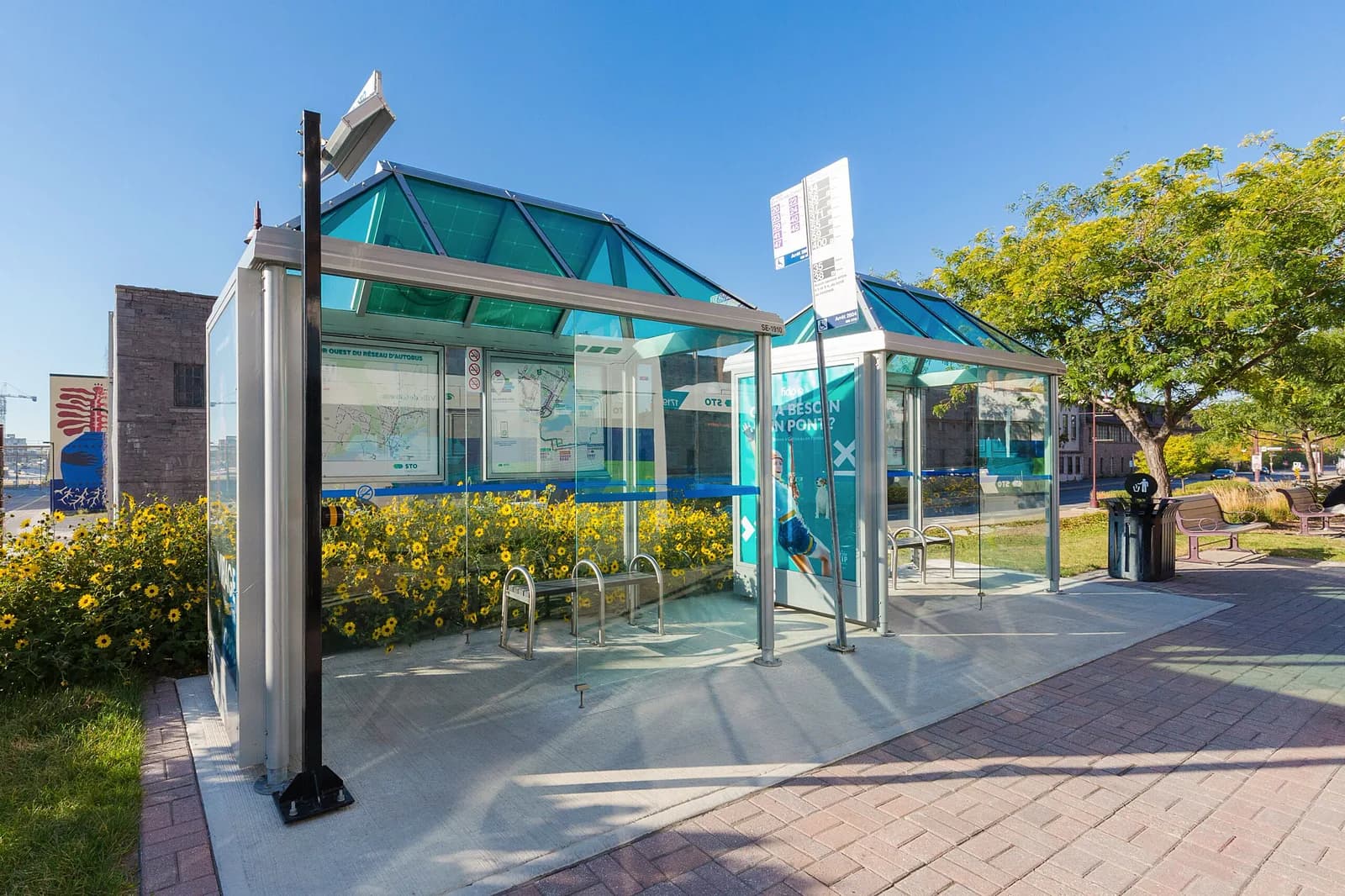
Solar-powered bus shelters add a roof-mounted PV array, charge controller, and lithium-iron-phosphate (LiFePO₄) battery so the shelter runs lighting, real-time arrival displays, and USB charging without a grid connection. This is the right specification for routes where trenching power costs more than the shelter itself — rural stops, suburban park-and-rides, Indigenous community routes, and university shuttle loops. BusShelters.ca solar shelters use 120–340 W monocrystalline panels (mono-Si, 21–22% efficiency) sized to the latitude of the install site. A Toronto shelter at 43.6° N sees roughly 3.6 peak sun hours in December; a Yellowknife shelter at 62.5° N sees 0.8 hours and gets a 2.5× panel oversize plus a heated battery enclosure. Battery capacity ranges from 100 Ah to 400 Ah at 12 V or 24 V, with 3–5 days of autonomy at the design-load duty cycle. Engineering specifications The lighting load is a 4000K LED array drawing 8–18 W with a PIR motion sensor that lifts to full brightness when a rider approaches and dims to 20% standby otherwise. USB-C ports (5 V / 3 A) and Qi wireless pads are optional. Real-time arrival displays use e-paper (BWR, 0.5 W average draw) rather than backlit LCD to keep duty-cycle inside the solar budget. The structure carries the same NBCC 2020 stamp as a standard shelter — snow load Ss, wind load q1/50, footings to local frost depth — plus a roof reinforcement to support the panel weight (18–28 kg per panel). Charge controllers are MPPT with Bluetooth telemetry; we ship a 5-year battery warranty and 25-year panel warranty. Solar shelters are deployed across Indigenous Services Canada community contracts, TransLink rural feeder routes, and Saskatchewan municipal procurements where prairie sun makes payback under 6 years. Installation, monitoring, and warranty Deployment and customer base Solar shelter installation is 3–5 working days including PV mounting, battery commissioning, and remote-telemetry setup. Crews are licensed Master Electricians in the destination province (Red Seal Construction Electrician 309A in ON, Sceau Rouge équivalent in QC). Once installed, every shelter reports state-of-charge, panel output, load history, and ambient temperature to our hosted dashboard by default — free for the first year, $120/year per shelter thereafter, or self-host the open-source agent for free. Warranty is 25 years on PV panels (linear power output), 5 years on the LiFePO₄ battery (80% capacity retention), 3 years on the charge controller, 10 years on the structure, and 2 years on lighting and electronics. Maintenance is minimal — annual panel cleaning and bi-annual battery state-of-health check — typically $200–$400 per shelter per year. Key Takeaway: Climate-rated, AODA-compliant, and stamped-engineered for Canadian transit deployment — full procurement documentation included.
Heated Bus Shelters
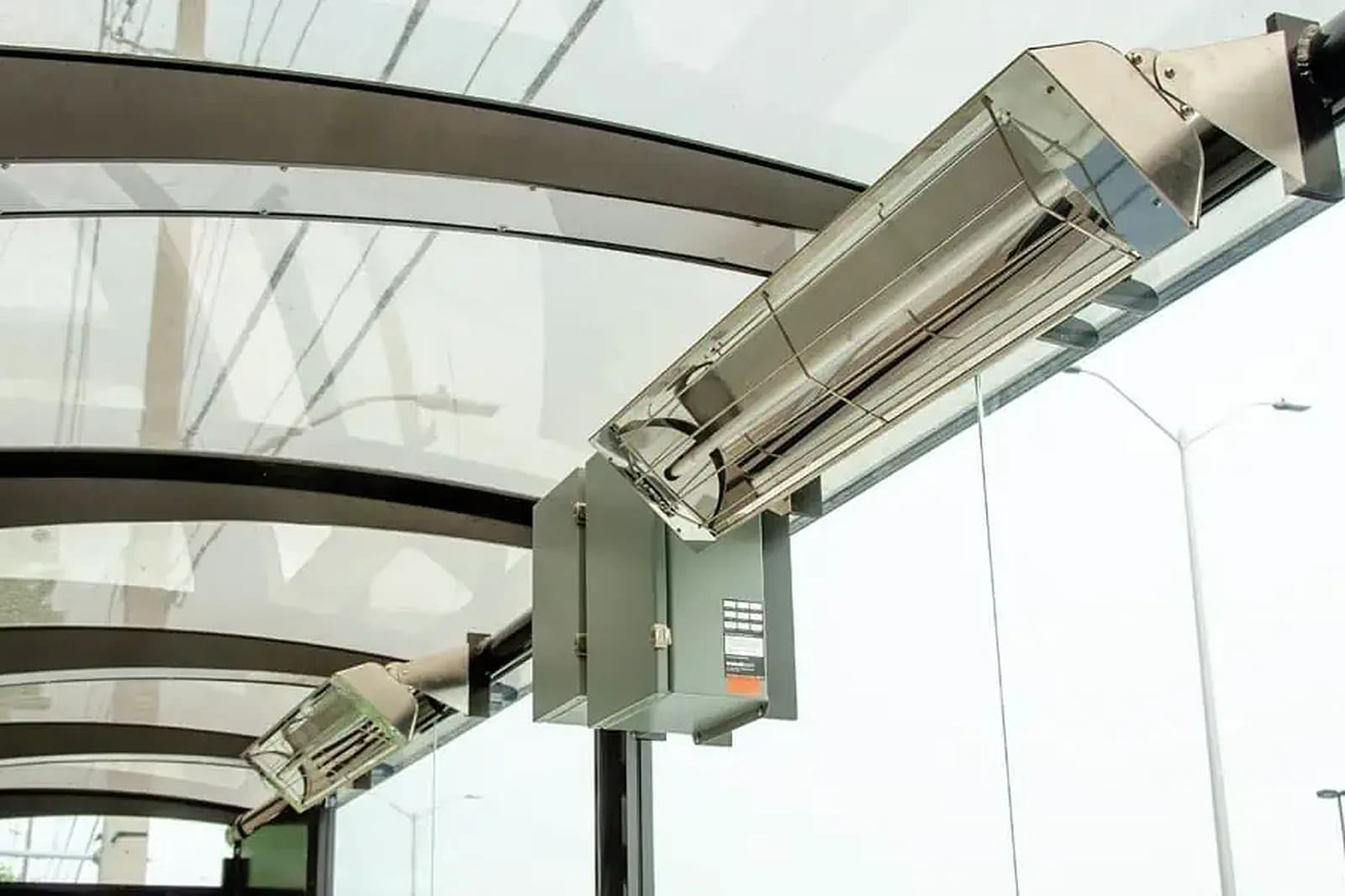
Heated bus shelters are essential on routes where waits exceed 10 minutes and outdoor temperatures drop below -15 °C — which is most of Canada from November through March. BusShelters.ca heated shelters use radiant ceiling panels rated 800–2400 W with a wall-mounted thermostat and PIR motion sensor that runs the heat only when a rider is present and dims to standby when empty. The heater is mounted to an insulated ceiling cassette to cut downward radiant losses and protect the heating element from condensation. Wall and roof glazing is double-glazed insulating glass unit (IGU) with argon fill and low-E coating, giving a U-value of 1.4 W/m²K versus 5.7 for single-pane — about 75% less heat loss through the walls. The bench can be specified with 250–400 W radiant heating in the seat surface, which is a Quebec-popular feature for elderly transit users. Engineering specifications Heated shelters require a 240 V single-phase service drop with a 15 A or 20 A circuit, GFCI-protected. We provide the electrical schedule, panel schedule, and stamped electrical-on-utility-pole diagram for the AHJ review. For sites without grid access, see our solar-heated combo which uses a 1500 W heater on a 600 Ah / 48 V battery — runs about 4 hours per day at -20 °C, sized for peak commute windows. Heated shelters are most often specified by STM (Montréal), OC Transpo (Ottawa), Edmonton Transit, Winnipeg Transit, Saskatoon Transit, hospital transit nodes, and university campuses. Lead time is 8–12 weeks. Pricing adds $3,000–$7,000 to the standard structure depending on heater wattage, bench heat option, and IGU spec. Installation, energy use, and warranty Deployment and customer base Heated-shelter installation is 3–5 working days including the electrical service drop, panel commissioning, and thermostat / PIR-sensor calibration. Energy consumption depends heavily on duty cycle: a 1500 W heater running 8 hours per day during a 5-month Canadian winter at PIR-driven 40% duty cycle uses about 720 kWh per shelter per season — at the typical commercial rate of $0.13/kWh that's $94 per shelter per winter. Smart-thermostat shelters cut this 30–45% by tightening the rider-presence window. Warranty is 10 years on the structure, 8 years on the IGU (sealed-unit failure), 3 years on the heater element, 5 years on the thermostat / PIR control, and 2 years on the bench heat. Annual maintenance is a fall pre-season heater test and gasket inspection — typically $250–$500 per shelter per year, plus winter call-out if the heater faults. Key Takeaway: Climate-rated, AODA-compliant, and stamped-engineered for Canadian transit deployment — full procurement documentation included.
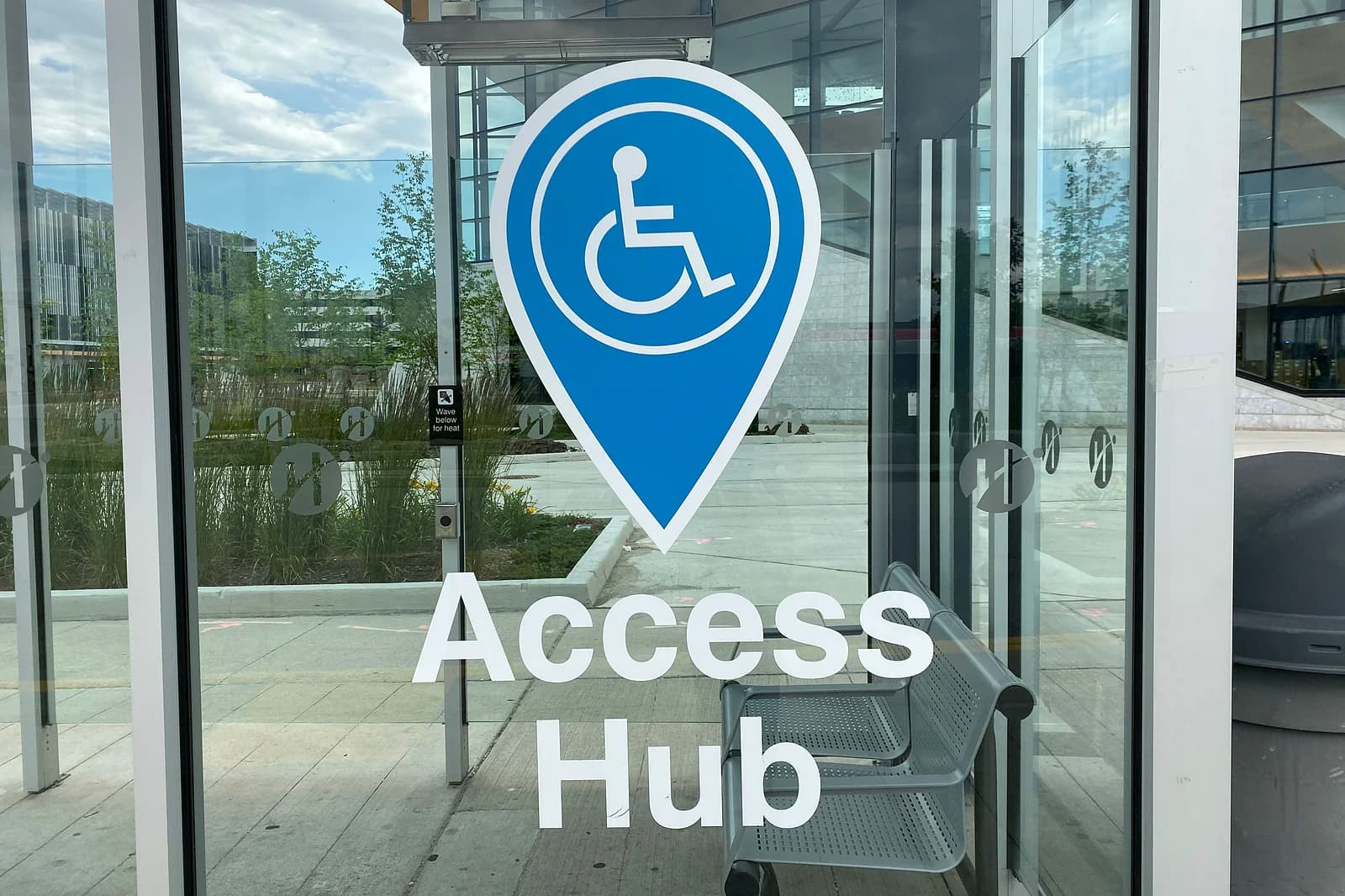
ADA & AODA Accessible Shelters
Accessible bus shelters meet AODA Design of Public Spaces (Ontario Reg. 413/12), CSA B651-18 Accessible Design for the Built Environment, the Quebec RBQ Chapter VIII, the BC Accessibility Act, and the Manitoba, Nova Scotia, Newfoundland, and federal Accessible Canada Act equivalents. Every BusShelters.ca shelter is accessible-by-default; this product line is the upgraded version with extra clear-floor space, tactile and contrast features, and the documentation pack required for transit-authority compliance audits. Core accessibility features include a clear floor area of 1500 mm × 1500 mm at the rider zone (CSA B651 7.5), a contrast strip at the door opening with 70% LRV contrast against the wall colour, tactile warning surface indicators (TWSI) at the boarding edge per CSA B651-18 6.1.4, and bench surfaces between 430 mm and 480 mm above grade with front and rear armrests for sit-to-stand assistance. Approach gradients are designed for 1:20 maximum running slope and 1:50 cross-slope to accommodate manual and power wheelchairs. Engineering specifications Visual accessibility is addressed with tactile lettering on route signage (raised characters 0.8–1.5 mm, CNIB-recommended sans-serif font), Braille route numbers (Grade 2 / UEB), and luminance-contrast pictograms with a minimum 3:1 contrast ratio against the panel. Lighting is 150 lux at the bench with anti-glare diffusers; a motion-activated audio announcer is available for vision-impaired riders. Optional hearing-loop induction system (T-coil compatible) integrates with real-time arrival audio. The compliance pack includes the AODA conformance letter, CSA B651-18 design checklist, dimensional accessibility drawings, and the photometric/contrast lab report — everything procurement teams need to clear an accessibility-board review. Lead time 8–12 weeks. Uplift over the standard shelter is $500–$1,200 depending on the visual-accessibility options selected. Documentation, audits, and warranty Deployment and customer base Every accessible shelter ships with a compliance binder containing the AODA conformance letter (or provincial equivalent), CSA B651-18 design checklist with each clause cross-referenced to the as-built drawings, photometric and contrast lab report, tactile surface manufacturer certifications, and the stamped accessibility-board review pack. This is the same documentation format used by the Ontario Public Service Accessibility Office, the Office québécois de la personne handicapée, and the Accessibility Directorate of BC for their own accessibility audits — most procurement teams can drop our binder straight into their submission with no edits. Warranty is 10 years on the structure, 5 years on tactile surfaces and Braille panels, 3 years on the audio announcer, 5 years on the hearing-loop system. Annual accessibility re-audit (visual and dimensional) is included in maintenance contracts at $400–$700 per shelter per year. Key Takeaway: Climate-rated, AODA-compliant, and stamped-engineered for Canadian transit deployment — full procurement documentation included.
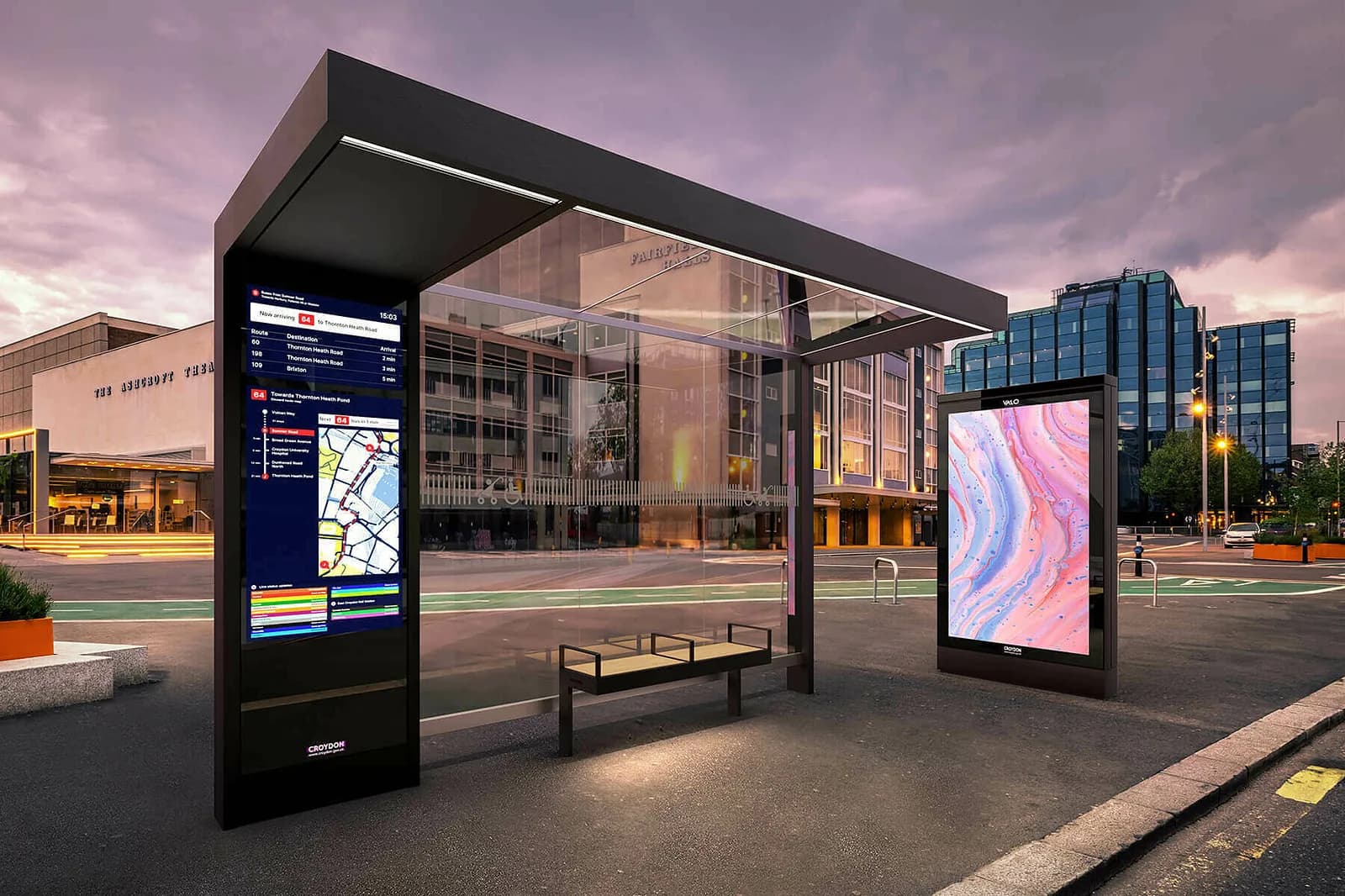
Smart Bus Shelters
Smart bus shelters combine the structure of a heated, accessible shelter with real-time arrival information, passenger-counting sensors, environmental telemetry, and rider-services electronics — turning a static piece of street furniture into an instrumented network node. BusShelters.ca smart shelters are deployed across TTC, STM, TransLink, OC Transpo, Calgary Transit, and corporate campuses where rider experience and operational data both matter. The arrival display is a 27- to 43-inch outdoor LCD rated 2500 nits (sunlight-readable) or, for off-grid sites, an e-paper panel with sub-second refresh and 0.5 W average draw. Both connect to GTFS-Realtime feeds via CAT-M / NB-IoT cellular with an LTE-M fallback. We support every Canadian transit-authority API (TTC, STM, TransLink, OC Transpo, Calgary, Edmonton, Winnipeg, Halifax) and provide the integration playbook with each shipment. Engineering specifications Sensor payload includes a passenger-count sensor (3D ToF, 95% accuracy), an air-quality sensor (PM2.5, PM10, CO₂, temperature, humidity), a dwell-time analytics module, and an anti-tamper accelerometer that flags the shelter to ops if it's struck or shifted. Rider-facing services are a USB-C charging panel (4 ports × 3 A), a Qi wireless pad, optional municipal Wi-Fi, and an emergency call button (SIP-over-cellular to 911 or a private security desk). The data plane is a small Linux SBC (industrial Raspberry Pi or NVIDIA Jetson Nano for AI workloads) running our open-source telemetry agent, MQTT-published to your transit-authority's data lake or to our hosted dashboard. 5-year SLA on cellular and dashboard, 3-year warranty on electronics. Smart shelters start at $15,000 for the structure and add $3,000–$8,000 for the sensor payload and connectivity. Integration, hosting, and warranty Deployment and customer base Smart-shelter onboarding is a 2-day workshop with your transit-authority IT team where we hand off the GTFS-Realtime integration, MQTT topic schema, dashboard credentials, and API documentation for every sensor stream. Hosting options are (a) BusShelters.ca cloud (AWS Canada Central, $240/year per shelter, includes 5-year SLA on data ingest and dashboard uptime), (b) self-host on your data lake (free; we provide the open-source agent and Helm chart), or (c) hybrid, where telemetry hits both. Warranty is 10 years on the structure, 3 years on the LCD/e-paper display, 5 years on the cellular modem, 3 years on sensors, and 2 years on rider-services electronics (USB / Qi / call button). Cellular data is $8/month per shelter on a pooled Canadian carrier plan. Firmware updates are OTA, signed and rolled per shelter cohort. For pilot deployments under 10 shelters we offer a 3-month evaluation programme with full hardware on loan, dashboard access, and a written case-study report at the end — most pilots convert to full procurement within the same fiscal year. Key Takeaway: Climate-rated, AODA-compliant, and stamped-engineered for Canadian transit deployment — full procurement documentation included.
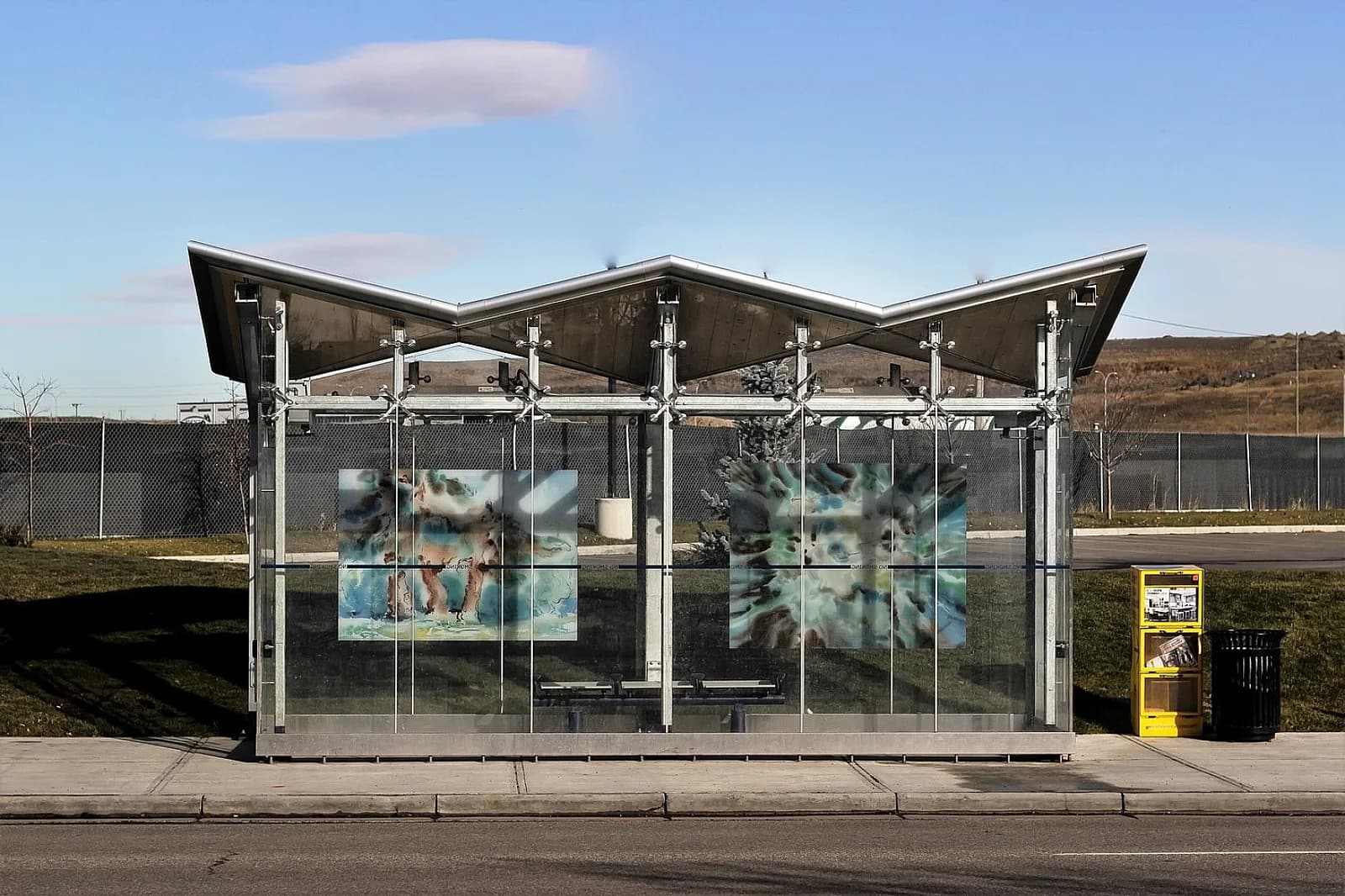
Custom Bus Shelters
Custom bus shelters are designed from the ground up to match heritage districts, campus master plans, brand-controlled streetscapes, and one-off architectural sites where a stock catalogue product won't pass design review. BusShelters.ca's in-house design studio runs the project from schematic through shop drawings, CSA-stamped engineering, fabrication, and installation supervision — typically a 14–22 week programme. Custom work begins with a design intent meeting where we capture the architectural language (timber-frame, all-glass, perforated cor-ten, terrazzo bench surrounds, integrated public art), the site context (heritage easement, campus master plan, transit-oriented development), the functional brief (heated, smart, accessible, advertising), and the budget envelope. We deliver 3 schematic options at week 2, a single developed design at week 4, and stamped construction documents at week 8. Materials we've used in past custom programmes include western red cedar timber-frame, fritted laminated glass, weathering steel (Cor-Ten A/B), anodized bronze aluminum, terrazzo benches, and glass-fibre-reinforced concrete (GFRC) roofs. Engineering specifications Engineering is stamped by a P.Eng. licensed in the destination province for snow load (NBCC 2020 Ss), wind load (q1/50), seismic Sa values (BC, QC), and footing design to local frost depth. Where the design pushes outside catalogue glazing, we model the IGU thermally and structurally and run a FEM analysis on the frame; expect 2–4 weeks of additional engineering for non-rectilinear geometries. Past custom programmes include heritage-district shelters in Old Montréal, Old Québec, Gastown (Vancouver), and Distillery District (Toronto); campus shelters at University of Toronto, McGill, UBC, and Université Laval; and brand-controlled installations for Pearson Airport, YVR, MTLPort, and Halifax Stanfield. Pricing typically lands $25,000–$60,000+ per shelter depending on materials and quantity. Project pricing, milestones, and warranty Deployment and customer base Custom programmes are fixed-fee per milestone rather than time-and-material: schematic design $8,500–$14,000, developed design $12,000–$22,000, construction documents $18,000–$45,000 (or rolled into per-unit unit pricing on quantity orders of 10+ shelters), fabrication and installation per shelter $25,000–$60,000+. Milestones are billed 30% on schematic acceptance, 30% on developed-design sign-off, 30% on fabrication start, 10% on substantial completion — the standard CCDC 2 progress-billing format used across Canadian public-sector procurement. Warranty matches our standard product line at 10 years structure / 5 years glazing and bench / 2 years lighting, with bespoke materials (timber, Cor-Ten, GFRC, terrazzo) carrying their respective material-house warranties pass-through. We also provide 5-year design-defect coverage on custom geometry — if the FEM model ever disagrees with field reality, we cover the rework. A dedicated project manager runs each engagement from kickoff through commissioning, with weekly status calls, a shared Smartsheet dashboard, and a single named P.Eng. point of contact for every engineering question. Key Takeaway: Climate-rated, AODA-compliant, and stamped-engineered for Canadian transit deployment — full procurement documentation included.
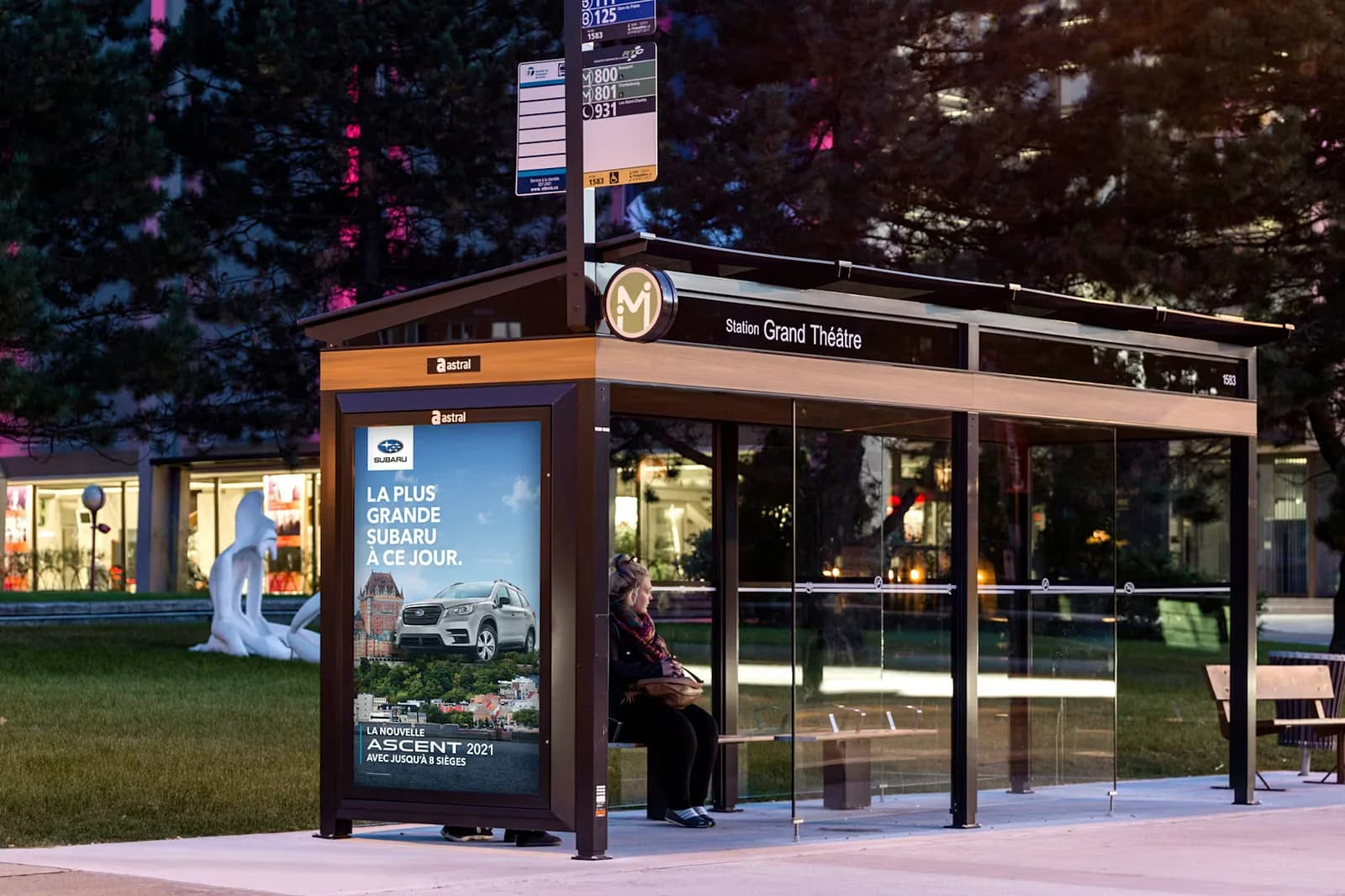
Advertising Bus Shelters
Advertising bus shelters integrate one or two back-lit poster panels (typically 6-sheet, 1200 × 1800 mm, the Canadian out-of-home standard) into a standard or heated shelter shell. The advertising revenue offsets the structure cost — and on high-traffic corridors can fully fund the shelter network. BusShelters.ca builds for both municipal direct-sell programmes and concessionaire models with JCDecaux Canada, Pattison Outdoor, Astral Out-of-Home, and OUTFRONT Canada. Each ad panel uses a 6500K LED light box with photometric uniformity ≥ 0.7 (no hot spots, no dark bands), running 45–80 W per panel with dawn/dusk photocell control. Panels are roll-changeable in under 4 minutes by a single tech using the supplied key — no tools, no glass removal — which keeps concessionaire OPEX low. Glass is anti-graffiti polycarbonate or laminated tempered glass; both pass the OAAA / OMA durability standard for poster-panel cover. Engineering specifications For digital advertising, we ship a 55- or 75-inch outdoor LCD rated 3500 nits with a 5-second to 15-second rotation, GPS-tagged playlist, and proof-of-play telemetry. Digital panels integrate with Hivestack, Vistar Media, Broadsign, and Place Exchange programmatic-DOOH platforms — every play is reported in the standard MRC-DOOH format with audited audience metrics from COMMB Canada. The panel placement and viewing geometry is designed for DDI compliance (ad doesn't obstruct the route timetable, doesn't degrade rider sightlines to oncoming buses, doesn't create driver distraction at intersections). We provide the TAC / municipal traffic-engineering review pack for every site. Lead time 6–10 weeks static, 8–12 weeks digital. Pricing adds $1,800–$4,500 static, $8,000–$16,000 digital to the standard structure. Revenue models, maintenance, and warranty Deployment and customer base Advertising shelters are deployed under three commercial models. Municipal direct-sell: the city owns the inventory and sells panel weeks directly — typical revenue $400–$1,200 per panel per 4-week period in Tier 1 corridors. Concessionaire model: a partner (JCDecaux, Pattison, Astral, OUTFRONT) installs, maintains, and sells the inventory in exchange for revenue share — the city pays zero capital cost and receives 8–18% of net ad revenue. Hybrid: city owns the structure, concessionaire sells the inventory. We've supported all three models in deployments across Toronto, Mississauga, Ottawa, Vancouver, Halifax, and Winnipeg. Warranty is 10 years on the structure, 5 years on the LED light box and 3 years on digital displays. Concessionaire-model maintenance is included in the partner agreement; municipal-direct sites typically run $600–$1,400 per shelter per year for poster-swap, panel cleaning, and lamp replacement. For municipalities exploring the model, we offer a revenue-share feasibility study that benchmarks your corridor against comparable Canadian markets and gives a 5-year revenue forecast — the study is free with any procurement of 25+ shelters. Key Takeaway: Climate-rated, AODA-compliant, and stamped-engineered for Canadian transit deployment — full procurement documentation included.
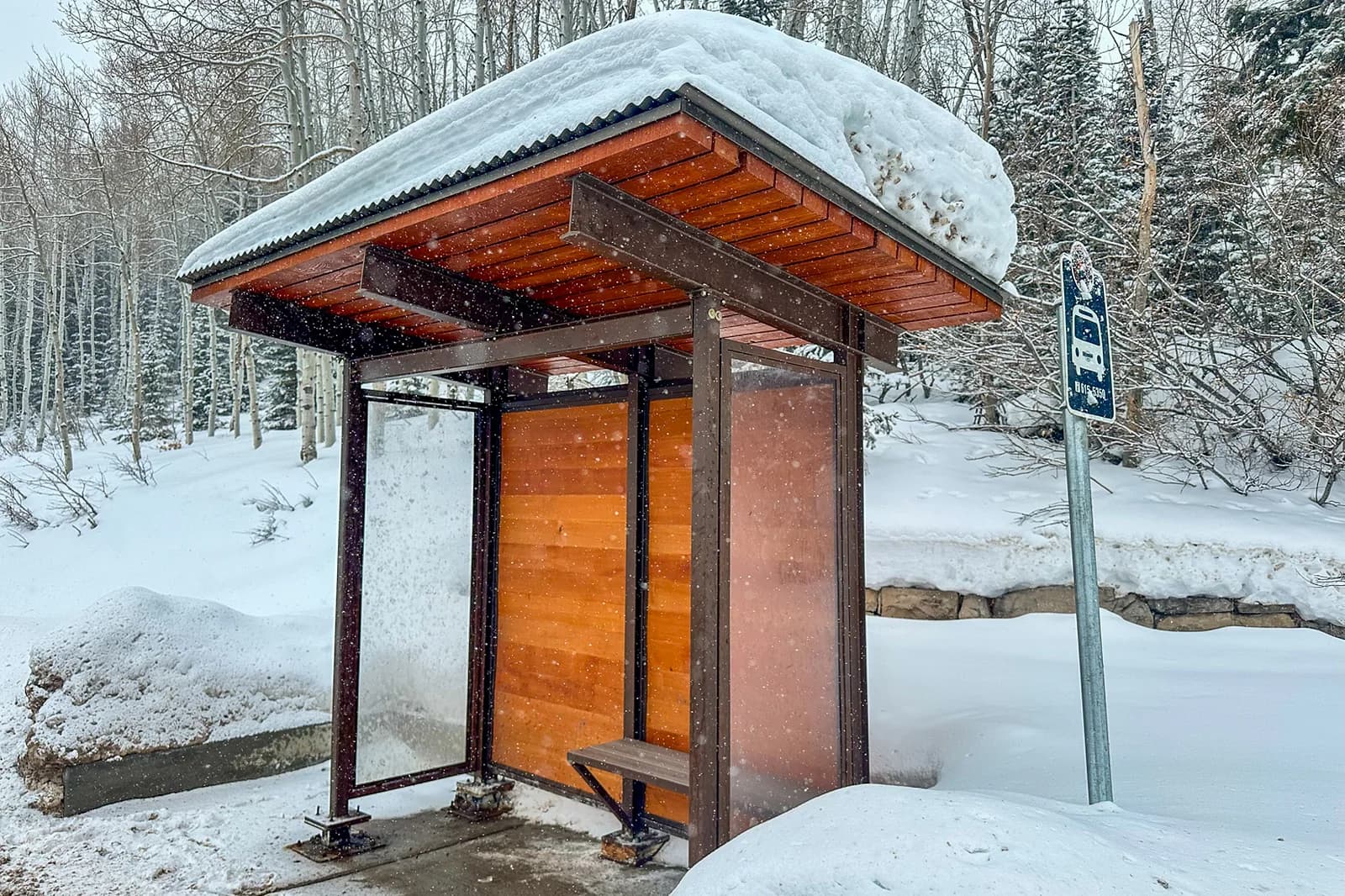
Modular Transit Shelters
Modular transit shelters are factory-pre-assembled in standardised bays that bolt together on site to create shelters of any length from 4 ft to 60 ft without custom engineering for each variant. The system uses a common 6063-T6 aluminum extrusion family with 3-bay, 5-bay, and 8-bay spans; each bay carries the snow and wind load locally, so the structure scales linearly with no engineering rework when you stretch from a 12 ft shelter to a 24 ft platform canopy. This is the right specification for bus terminals, BRT (Bus Rapid Transit) stations, light-rail interchange platforms, GO Transit park-and-ride canopies, and airport ground-transport zones where shelter length is tied to vehicle pull-up geometry rather than rider count. We've shipped 120 ft GO Transit canopies in 8-bay spans for Metrolinx and 24 ft BRT shelters for the Mississauga MiWay BRT programme. Engineering specifications Each bay is delivered factory-glazed, factory-wired (where lighting/heat/USB is specified), and ships in flat-pack format on standard 53-foot trailers — a 24 ft, 8-bay shelter fits in one trailer including bench, signage, and footing hardware. On-site assembly is 2 techs × 2 days per bay average; an 8-bay shelter is up in 4 working days excluding footings. Modular shelters carry the same NBCC 2020 stamps as our standard product, with bay-level snow-load and wind-load engineering plus a continuous-canopy moment connection at each bay junction. Glazing choice (single tempered, double IGU, or polycarbonate) and bench length are field-configurable — a procurement team can swap configurations between sites without a new engineering cycle. Lead time 8–14 weeks; pricing scales linearly per bay starting at $4,800 per bay structure-only. Phasing, expansion, and warranty Deployment and customer base A major advantage of the modular system is phased deployment: you can install a 3-bay shelter in year 1 and add 2 more bays in year 3 without removing the original — the bay junctions are designed to accept additions, and the engineering envelope already covers the longest configuration. This is how Metrolinx scaled GO Transit canopies as ridership grew at Mississauga, Oakville, and Burlington stations. Warranty is 10 years on the aluminum frame and bay junctions, 5 years on glazing, 3 years on bench, 2 years on lighting and electrical. The same warranty applies to bays added in later phases — your year-5 expansion bay carries a fresh 10-year clock from its install date, not the original commissioning. Maintenance contracts are priced per bay ($200–$400 per bay per year), so a 24-foot 8-bay shelter costs about the same to maintain as eight standalone shelters but with one site visit instead of eight. Key Takeaway: Climate-rated, AODA-compliant, and stamped-engineered for Canadian transit deployment — full procurement documentation included.
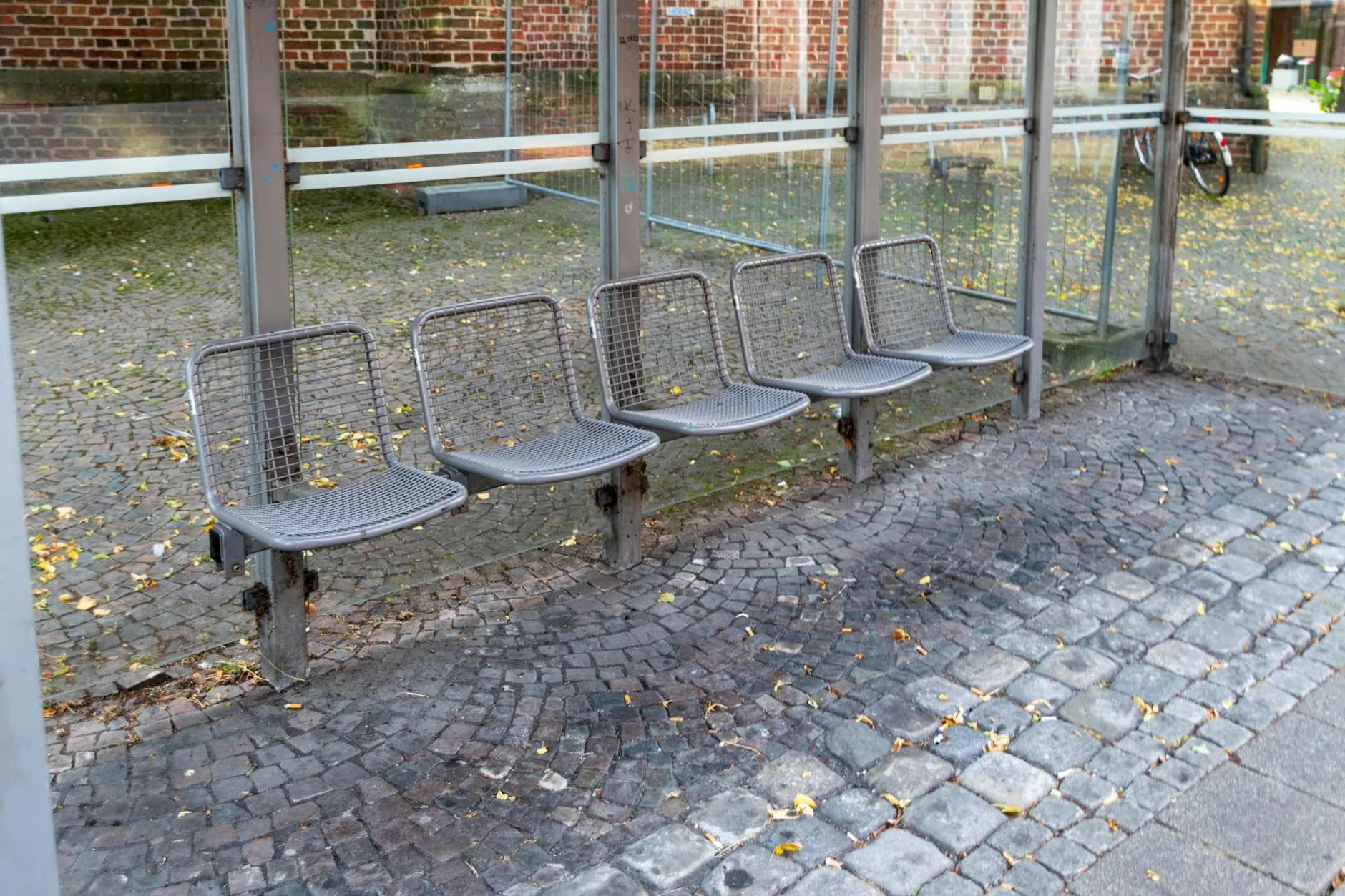
Bus Shelter Benches
Bus shelter benches are sold as a standalone product for sites where a full enclosed shelter isn't justified — low-frequency rural stops, signed-only school routes, downtown infill where a shelter would block sight lines, and patch-and-replace work on existing shelter networks. We ship benches in 1.2 m, 1.8 m, 2.4 m, and 3.0 m lengths with the same powder-coat colour library and AODA-armrest options as our shelter line. Standard construction is a 6063-T6 aluminum slat seat on a 6005A-T6 aluminum or hot-dip galvanized HSS steel substructure. Aluminum slats are 5 mm thick with a 12 mm air gap between for drainage and vandal-resistance (no continuous surface for marker tagging). Powder coat is AAMA 2604 for 10-year colour fastness in Canadian sun. We also offer recycled-plastic lumber (HDPE with 25-year warranty) for environmentally-conscious campuses, and perforated steel for transit-authority style matches. Engineering specifications Every bench is AODA / CSA B651-18 compliant by default — seat height 430–480 mm AFF, front and rear armrests for sit-to-stand, anti-skateboard caps at corners, and 70% LRV contrast between seat and substructure for low-vision rider visibility. Heated bench surfaces (250–400 W radiant) are available for grid-connected sites; warmer-handle seat noses are an additional cold-weather option for STM and Quebec deployments. Footings are designed to local frost depth and ship with anchor templates and drilling jigs. Benches are deployed across Toronto Transit Commission, STM, Calgary Transit, Saskatoon Transit, and several rural Saskatchewan and Manitoba routes. Lead time 4–6 weeks for standard configurations. Pricing starts at $1,200 for a 1.8 m bench structure plus $400–$900 for installation. Installation, accessories, and warranty Deployment and customer base Bench installation is a half-day to full-day job per location depending on whether you're using cast-in-place footings, pre-cast piers, or surface-mount tamper-resistant bolts (suitable for sites with no frost concern, e.g. covered concourses). Anchor templates and drilling jigs ship with every order so a municipal works crew can self-install — the on-site programme is typically 2 techs, 1 day, 4 benches including footing pours. Warranty is 15 years on the aluminum frame and substructure, 25 years on recycled-HDPE lumber slats (manufacturer pass-through), 10 years on powder-coat finish (AAMA 2604), 3 years on the heated-seat element, and 5 years on tactile/contrast components. Accessories are stocked at the Brantford warehouse with 48-hour shipping: replacement slats, end caps, armrests, anti-skateboard caps, and tamper-resistant fasteners. Volume contracts (50+ benches per year) trigger 15–22% pricing reductions. For school boards and small municipalities, our bench-only starter kit bundles four 1.8 m benches, anchor templates, and an installation video for under $7,500 delivered — an entry point that fits most discretionary works budgets. Key Takeaway: Climate-rated, AODA-compliant, and stamped-engineered for Canadian transit deployment — full procurement documentation included.
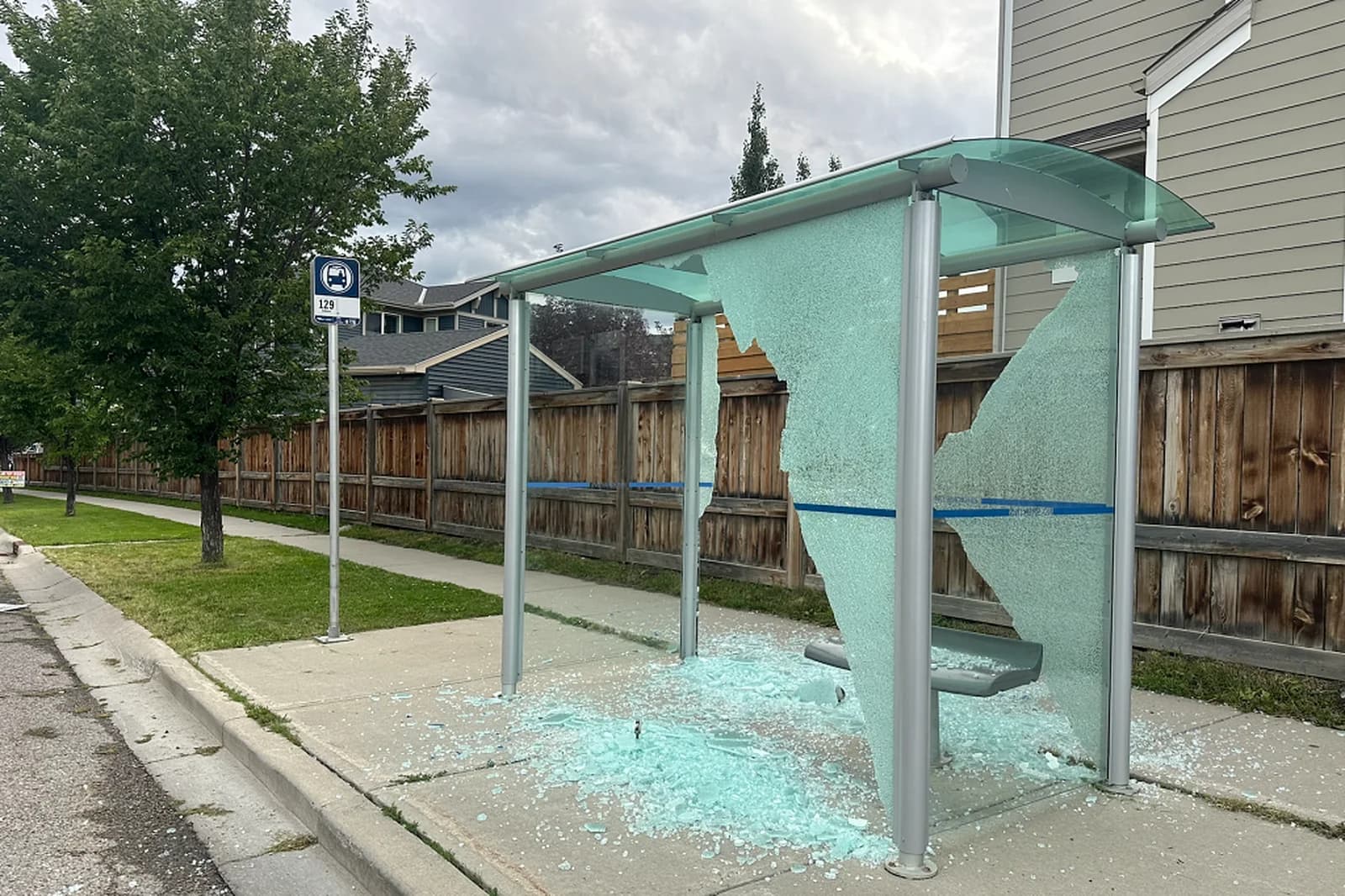
Replacement Glass & Panels
Replacement glass and panels keep an existing shelter network in service after vandalism, vehicle impact, weather damage, or planned refresh cycles. BusShelters.ca stocks 6 mm tempered glass in our 12 most-shipped panel sizes plus 8 mm and 10 mm polycarbonate in the same dimensions, ready to ship from our Brantford, Ontario warehouse — 48-hour delivery on stock items anywhere in Ontario, Quebec, and the Maritimes; 5–7 days to Western Canada and the territories. We carry replacement glass not only for our own shelters but for most major Canadian shelter brands — Daytech, Tolar, Brasco International, Creative Outdoor, JCDecaux, Pattison, and Astral. Provide the shelter make/model and panel position (front, side, rear, door) and we'll ship the correct curved or flat panel cut to within ±1 mm of the original. For shelters where the make is unknown, we can dispatch a measurement tech with a digital photogrammetry kit (Ontario / Quebec same-week, rest of Canada within 7 days) and produce shop drawings for a custom panel run. Engineering specifications Panels ship with clip-in mounting hardware matched to your shelter brand, edge-protection foam, anti-graffiti film (sacrificial or permanent), and a handling guide that lets a single tech swap a panel in 15–30 minutes. We also stock route-map holders, schedule clips, bench slats, bench end caps, roof drainage strips, and anti-graffiti film rolls in 1.2 m × 50 m — most maintenance teams keep a stocking-package on shelf to cover the year's vandalism budget. Volume contracts are available for transit-authority maintenance programmes with annual stocking commitments of 50–500 panels; pricing drops 20–35% at the 100-panel tier. Standard panel pricing is $180–$450 depending on size and substrate. Same-day quotes via the maintenance hotline: (833) 5458 - BUS (287). Stocking programmes, warranty, and emergency response Deployment and customer base Stocking programmes are how transit authorities and municipalities run an efficient panel-replacement operation: we hold a buffer inventory of your most-frequently-vandalised SKUs in our Brantford warehouse under a dedicated stocking SKU, and ship within 24 hours of your maintenance ticket via dedicated freight. Stocking commitments range from 50 panels per year (small municipality) to 500+ panels per year (TTC, STM, TransLink scale). Warranty on replacement panels is 5 years against breakage from material defect, 2 years on anti-graffiti coating (sacrificial film replaced as a consumable, permanent fluoropolymer covered for the 2-year term), and a lifetime guarantee on dimensional accuracy — if a replacement panel doesn't fit the shelter it was specified for, we replace it free of charge including freight. Emergency response: panels needed for safety-critical breakage (jagged glass at a transit stop) ship same-day from Brantford on a dedicated courier — $280 freight uplift, available Monday-Friday 8am to 5pm Eastern. Key Takeaway: Climate-rated, AODA-compliant, and stamped-engineered for Canadian transit deployment — full procurement documentation included.
Ready to start your project?
Send us your scope, RFP, or specification — our bid desk responds within one business day.