
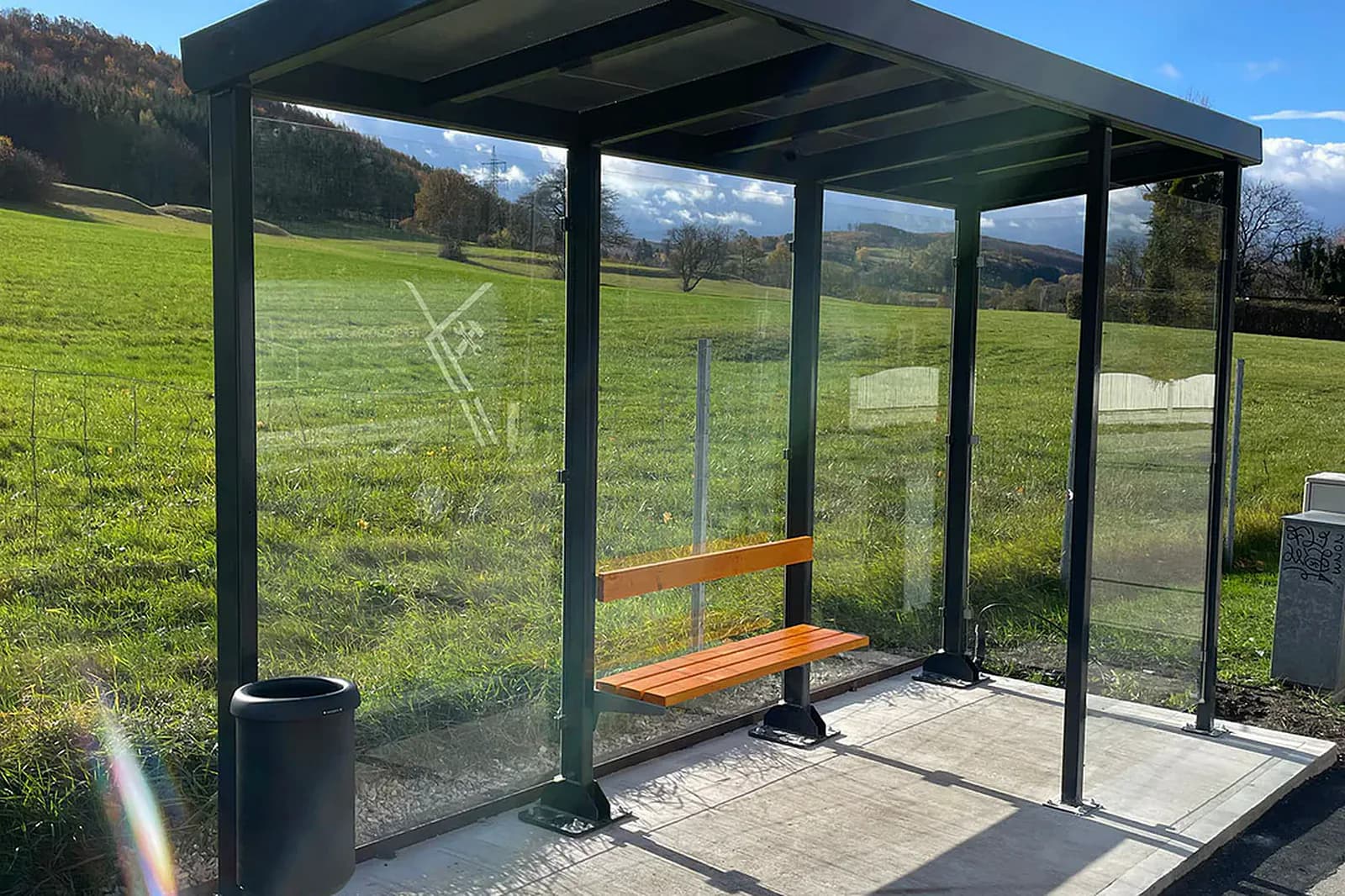
Buying a bus shelter in Canada is a different exercise depending on who is buying. A municipality with a transit authority runs an RFP. A university or hospital orders direct from a supplier. A property developer rolls it into a site-development tender. The shelter is the same in all three cases — engineered for the city's snow load, frost depth, and accessibility code — but the procurement path is not. This guide walks the four most common Canadian procurement paths and shows what to expect at each stage.
When you need a bus shelter
The shelter market in Canada has four buyer types, each with a different procurement path:
- Transit authority / municipality — TTC, STM, Translink, OC Transpo, Calgary Transit, plus 100+ smaller regional systems. Always RFP. Lead time from RFP issue to install: 16 to 32 weeks.
- University, hospital, or institutional campus — direct purchase from supplier with a campus capital-projects PO. Lead time: 8 to 12 weeks.
- Property developer / private site — rolled into a site-development tender or purchased direct. Lead time: 8 to 14 weeks.
- First Nations community / remote site — direct purchase plus shipping logistics for fly-in or barge-in destinations. Lead time: 12 to 20 weeks plus shipping window.
What 'prefabricated' actually means
Nearly every bus shelter sold in Canada is prefabricated — manufactured in a controlled facility, shipped flat or partially-assembled, installed on-site over a prepared foundation pad. The alternative is field-constructed (rare; used for architectural one-off shelters). The procurement choice between standard prefabricated and custom prefabricated comes down to two questions: do the standard footprints fit the site, and do the standard finishes match the public-realm standard for the city.
Standard prefabricated shelters ship in 6 to 8 weeks from PO. Custom prefabricated — different footprint, different finish, different roof profile, integrated advertising or digital display — ship in 10 to 16 weeks. Architectural one-offs (signature transit stops, named-donor commemorative shelters) run 16 to 24 weeks because the engineering review and finish-sample approval cycles get longer.
Where shelters ship from
Most Canadian-spec shelters ship from Ontario or Quebec manufacturing facilities — Brantford ON, Mississauga ON, Boucherville QC, Saint-Hubert QC are the typical origin points. Shipping cost runs $400 to $1,200 per shelter to Atlantic Canada, $300 to $900 within Ontario and Quebec, $800 to $2,400 to the Prairies, $1,400 to $3,800 to BC, and $2,800 to $6,500 to the territories. For First Nations and remote-fly-in communities, shipping logistics can dominate the budget — expect $8,000 to $15,000 per shelter for barge-in or short-haul-flight destinations.
Canadian buyers should ask the supplier where the shelter manufactures, where the components are sourced from, and whether the supplier can manage installation logistics (most can; some require the buyer to coordinate the install crew separately). 'Made in Canada' is not the same as 'manufactured in Canada' — many shelters use US-sourced glass and aluminum extrusion. The full Canadian-content number is usually 65% to 85% for shelters from established CA manufacturers.
RFP vs direct purchase
The choice between RFP (request for proposal) and direct purchase is a function of buyer type and dollar value. Public-sector buyers under municipal procurement rules require RFPs above a threshold (commonly $25,000 to $100,000 depending on the municipality). Private-sector buyers can go direct at any dollar value. Within the public sector, single-source justifications can sometimes substitute for an RFP if the buyer needs to match an existing fleet of shelters from one supplier.
RFP cycle: 6 to 12 weeks from issue to award, plus 6 to 8 weeks from award to install. Direct purchase: 2 to 3 weeks from quote to PO, plus 6 to 8 weeks from PO to install. The RFP cycle adds 8 to 12 weeks to the total, but produces a documented competitive process — important for council reviews, audit trails, and First Nations community processes that require transparent procurement.
What goes in a bus shelter RFP
A Canadian bus shelter RFP has six core technical clauses:
- Snow load (Ss) in kPa matched to the destination city per NBCC 2020.
- Wind load (q1/50) in kPa matched to the destination city.
- Footing depth in metres matched to municipal frost-depth standard.
- Glazing spec — 6 mm tempered, 8 mm tempered, or laminated, with U-value and impact rating.
- Heating spec if applicable — wattage, control method (PIR or thermostat), bench-heat option.
- Accessibility documentation pack — provincial standard plus CSA B651-18 cross-reference.
What to expect from a Canadian supplier
A reputable Canadian bus shelter supplier provides:
- Stamped engineering drawings for the destination city's snow, wind, and frost-depth requirements (not generic drawings).
- Bilingual procurement support — submission documents and technical data sheets in English and French.
- Provincial seal of engineer if required by the local AHJ.
- Pre-construction soil-bearing test coordination if the site is on reclaimed land or roadside fill.
- Installation crew bonding and insurance for public-sector prevailing-wage requirements.
- Spare-parts inventory at a Canadian distribution centre with documented replacement SLA.
- End-of-life take-back or refurbishment option, important for circular-economy procurement clauses.
Bus shelters near me — the regional reality
Most Canadian buyers searching 'bus shelters near me' actually want 'bus shelters delivered and installed in my city', not 'bus shelters manufactured in my city'. The Canadian shelter manufacturing footprint is concentrated in southern Ontario and southern Quebec — that's where shelters are built, then shipped nationwide. A buyer in Vancouver, Halifax, or Yellowknife is buying a shelter that ships from Brantford or Boucherville.
The relevant 'near me' question is which supplier installs in my market. Established Canadian suppliers run regional install crews bonded for prevailing-wage public-sector work in all 10 provinces and 3 territories. Smaller suppliers may install only in the Quebec-Ontario corridor and require the buyer to coordinate install crews independently for Atlantic, Prairie, BC, or northern destinations. Always ask the supplier for a list of recent installs in the destination province and reference contacts.
Total cost of ownership
A Canadian bus shelter costs $8,000 to $35,000 at first install (standard prefabricated, mid-range climate, no heating). Heated and smart options bump that to $15,000 to $55,000. Custom architectural runs $30,000 to $80,000+.
Over a 15-year service life, total cost of ownership lands at $1,000 to $1,800 per shelter per year including: annual maintenance, glazing replacement at year 5 to 8, finish refresh at year 7 to 10, and minor structural repairs. Heated shelters add $94 per shelter per winter in operating cost at typical Canadian commercial electricity rates.
Related resources
- Standard bus shelters — the most common prefabricated configuration
- Heated bus shelters — winter procurement option
- Solar-powered bus shelters — off-grid configuration
- Bus shelters for Canadian winters guide — climate spec deep dive
- AODA bus shelter checklist — accessibility procurement
- Request a quote
FAQ
How much does a bus shelter cost in Canada?
Standard prefabricated: $8,000 to $35,000 first cost. Heated or smart: $15,000 to $55,000. Custom architectural: $30,000 to $80,000+. Total cost of ownership over 15 years: $1,000 to $1,800 per shelter per year including maintenance.
Where are Canadian bus shelters manufactured?
Most Canadian shelters manufacture in southern Ontario (Brantford, Mississauga area) or southern Quebec (Boucherville, Saint-Hubert area). They ship nationwide; install crews are regional and bonded for local prevailing-wage requirements.
Do I need to run an RFP?
Public-sector buyers usually do, above a $25,000 to $100,000 threshold depending on the municipality. Private-sector buyers can purchase direct at any dollar value. Single-source justifications can substitute for an RFP if matching an existing fleet.
What is the lead time?
Standard prefabricated: 6 to 8 weeks from PO. Custom prefabricated: 10 to 16 weeks. RFP cycle adds 6 to 12 weeks to the front.
Can a bus shelter be shipped to a remote community?
Yes. Atlantic, Prairie, BC, and northern destinations are routine. First Nations and fly-in communities require shipping logistics planning — expect $8,000 to $15,000 per shelter for barge-in or short-haul-flight destinations on top of shelter cost.